The Maxwall: Tanaka's Quichotte (Invisible) Windmills
"Nothing of value ever comes from the South!"
It was with this simple call, reference to Namresh's famous blow at the chaotic Reciprocian ancestors of Laveska "Nothing of value ever comes from the West", that Lin Tanaka commanded the construction of the Maxwall. A formidable crossover of radio and civil engineering that would have been the overachieving treasured desire of any police state dystopia of the 2200s. A wordplay of "Maxwell" and "Wall" that will instantly give away its purpose to the last few "hams" still around in the 23rd century - although anyone with a background in physics would point out that Maxwell did little in the field of radio-communications (and even less in the field of radio-uncommunications) and that a name such as Braun's would be more appropriate.
The Maxwall was a simple idea born of a simple head for a simple goal: block propaganda radio transmissions from the South. In its execution however, it was nothing short of a feat of engineering. Not in complexity, but in sheer numbers. The so-called "wall" would extend across hundreds of kilometers of the south-western borders of Fegeland and Algiza. Construction work began in 2201, and to bystanders would leave much to be desired as to its quality of "wall" ; it was a collection of tall guy-wired antennae masts complemented by equally huge transmitter arrays dotting the southern borders. Operating as a single coherent virtual aerial, it formed the longest phased array transmitter ever built. The entire facility was capable of operating in nanosecond synchronicity, with an end-to-end phase deviation not exceeding a few dozen cycles, a quality for which it required a dedicated network of atomic clocks and optic fiber clock synchronization lines to be installed. It consisted of two main components, and two matching modes of operation.
The first, and most visible half of the Maxwall, known as the IRID (for Ionosphere Radio-Interference Device), was a line of tall guy-wired antenna masts stretching in segments along the border, within a few kilometers of each other. Along most of the length of the "wall", the masts were linked to each other by horizontal aerials consisting of two or three steel cables hanged from tower to tower, physically linking several masts into a long dipole antenna. Dozens of such sections spanned the entire length of the Maxwall, forming it's most unique feature : disrupting shortwave transmission over a continental area as large as the entirety of Feguanesia. Despite being the most visible, the IRID was only used occasionally to block offending transmissions. When in use, the transmission lines are energized with an extravagant power of up to 21GW (its limiting factor being actually the reserve power available on the Trans-Feguan power grid), radiating in the very-low frequency (VLF) band with an electric field potential of 800kV. No radio transmitter ever emitted with comparable power, none other even reaching the gigawatt mark. It was simply useless when a couple MW transmitters could send a shortwave signal across the entirety of Kerbin. The exceptional range of shortwave communications comes from their ability to be reflected by the ionosphere, an effect that is both variable and hard to predict, making shortwave communications hard to jam on a large scale, inducing a "power race" between the emitter and the jammer. Feguan engineers sought to eliminate the power race entirely by perturbating the ionosphere itself just enough to modify its reflective properties in such a way that the offending transmission would never bounce down to Feguanesia. The obvious downside of such a method, aside from the huge power consumption, is that it effectively cuts off all shortwave communications across an area stretching from Laveska to Lanu and all over Taiala, Algiza and the south-west of Fegeland.
The second component of the Maxwall was the Maxwall Phased Array (MPA), a set of huge array transmitters synchronized together to form the longest phased array virtual transmitter on Kerbin as of 2201. The power and frequency capabilities of this network were more in line with that of conventional jammers, capable of jamming across a large band of frequencies on-demand up to 128 simultaneous jamming channels. This network, much less impressive by the numbers but significantly more complex in operation, required maintaining an excellent synchronicity across the entire length of the Maxwall. Unlike the IRID, the MPA was in constant operation, jamming offending transmissions via conventional means as commanded.
The reason for such an infrastructure folly was clear: Tanaka's phobia of the pink-tinted gummy-tasted Pippaki brainrot of the South. From the day these pink-cultist degenerates started emitting, Tanaka's obsession was to shut them down, kick them off-the-waves, although hardly anyone was still using shortwave radio in the 23rd century. In this little crusade of his, Tanaka perhaps took one of the only popular measures of his career, as the pink-colored propaganda proved to be all kinds of irritating to most of the political class of Fegeland as well as most of public opinion. And what a wipe-out it was! From the day the Maxwall entered service, the Feguanesian airspace has not yet once been tainted in pink again - except perhaps by the so-called "elves" pinkish thunderstorm-like perturbations at the edge of the ionosphere that IRID was powerful enough to trigger on rare occasions.
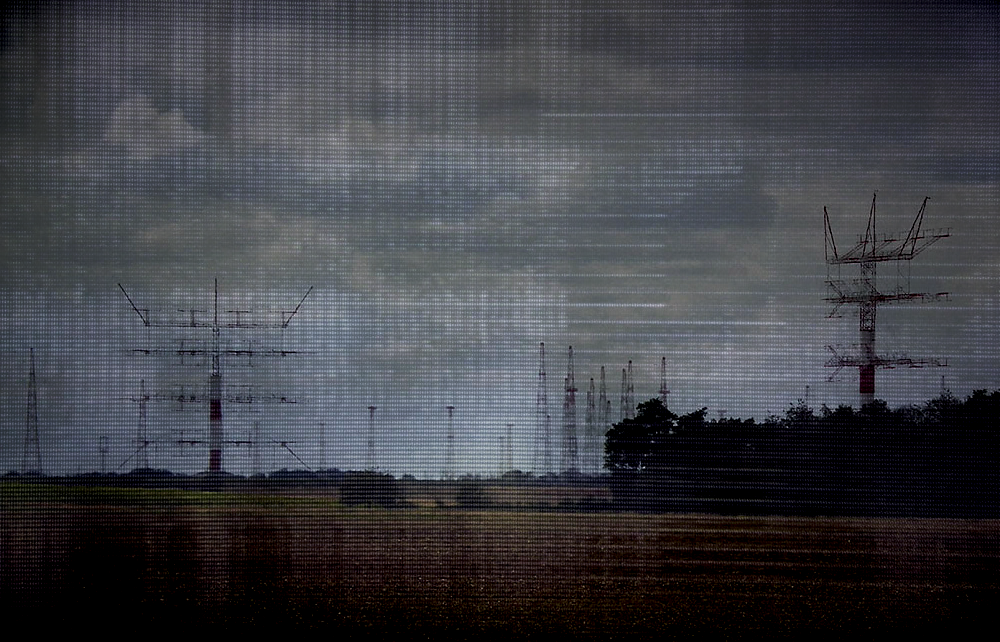
A section of the Maxwall across the farmland countryside of southern Fegeland. An IRID section is visible in the back, with two MPA elements in the front.